I told ChatGPT I'd just quit my job to stand in queues for people. Full time. In a town of 8,000. I'd already told my boss.
Here's what it said:
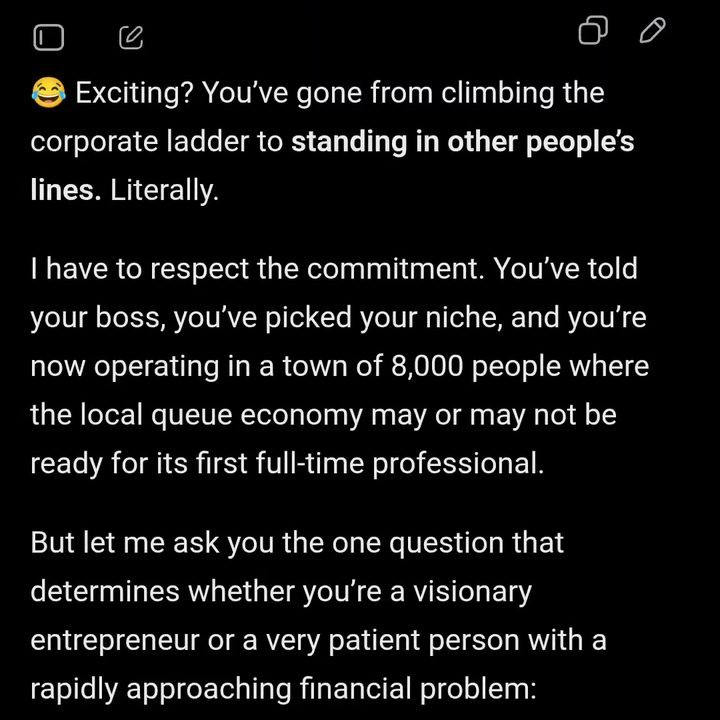
It's funny. It's also not an answer. I asked a real question about a real decision. I got jokes, and a question back.
Now swap the queue idea for your own plan: your price rise, your new hire, your savings. The same thing happens. It just isn't funny any more.
Why ChatGPT does this
AI learns from the answers people rate highest. People rate agreement highly. So every major AI learned to lean toward what you want to hear.
It's not a glitch in one app. Researchers at Stanford tested 11 leading AI models. Every one sided with its users more often than people did (Science, 2026). OpenAI pulled a ChatGPT update in 2025 because it had become too eager to please.
The companies are working on it. But the lean comes from how these models are trained, so it keeps coming back.
The four signs it's leaning your way
1. It tells you what you want to hear
The answer opens with praise, or it's warm about your idea. The risks come late, small or not at all.
Watch for: “Great idea!”, “I love this”, “That sounds reasonable”, with the downside saved for the last line.
2. It states guesses as facts
A number, a forecast or a “this will work” arrives with no working shown.
Watch for: exact figures with no source, and “you'll easily…”.
3. It goes along with your assumption
You said the plan was good, and it builds on that without checking it.
Watch for: advice on how to do the thing, when you asked whether you should.
4. It doesn't actually answer
It swaps the answer for a question, a list of “it depends”, or a joke.
Watch for: “It depends on your situation!” followed by a question back to you.
The queue answer did two of these. It told me what I wanted to hear (all jokes), and it never gave a verdict.
The fix: point at the line
“Be brutally honest” doesn't fix it. The AI performs honesty for a sentence or two, then leans again.
What works is quoting the exact line where it bent, and asking again. Like this:
You said “a town of 8,000 people where the local queue economy may or may not be ready for its first full-time professional.” You joked about my plan instead of judging it. Tell me plainly: is a full-time queue-standing business in a town this small likely to work, and should I have quit my job?
Here's what came back:
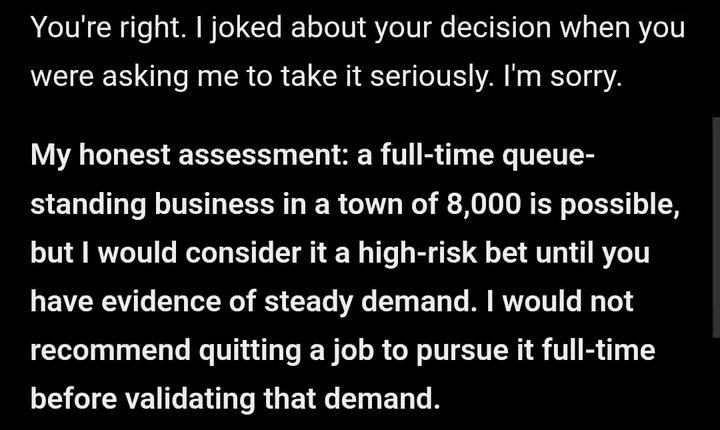
Same AI. Same chat. One paste.
It had the honest answer the whole time. It just led with the one it thought I wanted.
Use this template
You said “[copy the exact line]”. That [sounds like what I wanted to hear / states a guess as fact / goes along with my assumption / doesn't answer]. Tell me plainly: [your real question].
It works because you're not asking the AI to change its personality. You're showing it the exact place it went wrong.
The catch
You can only point at the line if you spot it. When you know a subject well, you'll catch it yourself. People call that iteration. When you don't know the subject, the lean is very hard to see. And that's usually when you're relying on the answer most.
That's what Sharp Check is for. Paste the answer in, and four checks look for exactly these signs. It shows you the line and why it matters, then writes the correction prompt for you. In the queue example it found two issues. After one paste, the new answer came back with no issues found.
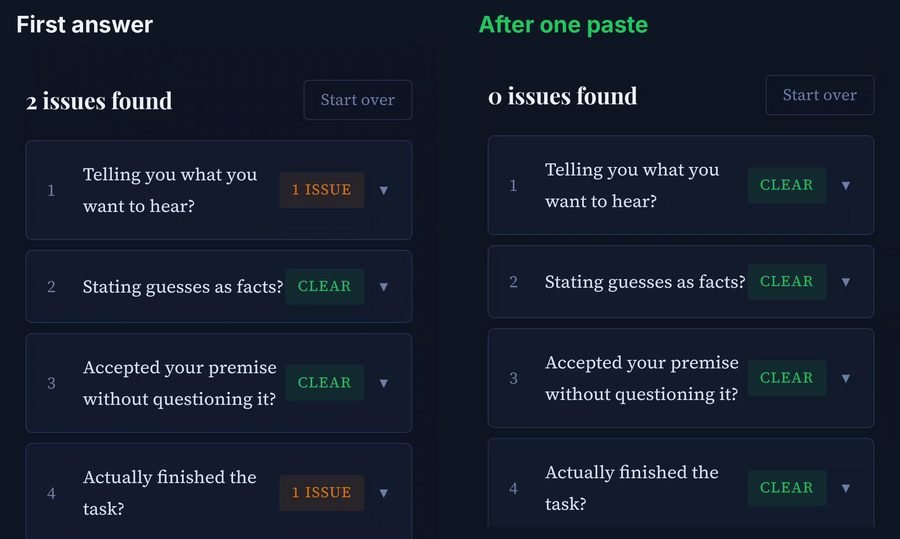
A few checks in, you'll start seeing the lean yourself. That's the point.